Pottery & Artifacts
Drawing an artifact for publication
A pot illustration decides the vessel’s profile, its scale, and which surface details are legible long before anyone sets up a camera.
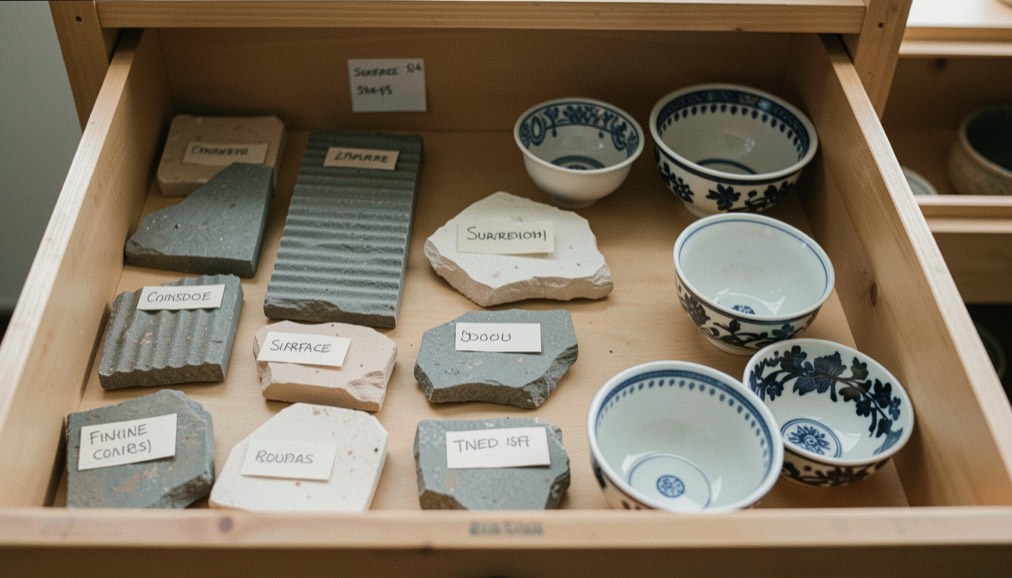
A pot illustration decides the vessel's profile, its scale, and which surface details are legible long before anyone sets up a camera. The drawing is not a preliminary to the photograph; it is an argument about the shape, made in line, and the photograph is taken afterward to confirm or complicate it. In most site reports the profile drawing carries the typological weight, while the photograph documents surface and condition.
Why draw a pot at all when a camera is available?
A camera records what the light does to a surface. A drawn profile records what the wall of the vessel does in section, and that is a different kind of claim. A photograph of a whole pot flattens the curve of the rim and the swell of the body into a single silhouette; the eye reads the near wall and loses the far one. A profile drawing, taken at the axis, shows both walls at once and lets the illustrator mark the thickness of the paste, the angle of the rim, and the point where the shoulder turns.
Scale is the second reason. A photograph includes a scale bar, but the bar sits in the same plane as the object only if the camera is square to it. A drawing is built to a stated scale, usually one to one or one to two, and the reader can measure the original from the page. For a sherd that will be compared against a type collection, that measurability is the point.
There is also the matter of what the camera cannot see. A broken edge, a coil seam, a slip line under the surface, a mend drilled in antiquity: these read clearly in a careful drawing and disappear in a photograph unless the light is raked just so. The illustrator decides which of them belong in the record, and that decision is editorial before it is technical. Anyone who has worked through a style guide for a regional publication will recognize the same problem, deciding what a reader needs to see and what can be left to the caption, a question that comes up in the writing and illustration trade as much as in archaeology. The Carolina children's writing magazine treats those decisions as craft questions rather than afterthoughts, and the same holds for a ceramic plate.
What does the profile drawing fix before the photograph?
The profile fixes the axis. The illustrator sets the vessel upright on the page, which means deciding where the base sits and how much of the rim is missing. A pot that leans in the ground or rests on a padded mount in the lab is not upright; the drawing corrects for that, and the correction is a judgment the reader never sees.
The profile fixes the rim diameter. Where the rim is broken, the illustrator projects the curve from the surviving arc and states the projected diameter, often with a dashed line. A photograph of the same sherd shows a fragment; the drawing shows the vessel it came from, with the projection marked as projection.
The profile fixes the wall thickness. Section lines at the rim, the shoulder, and the base give the reader the range, not a single number. Thick and thin walls on the same vessel are common, and a photograph taken from outside cannot show them.
The profile fixes the orientation of decoration. A painted band that runs around the body has to be drawn as if unrolled or as if seen from the side, and the choice changes what the reader thinks the design does. Painted designs on Southwest ceramics are frequently read as bands, panels, or wraparound figures, and the drawing commits to one reading.
How does scale work in a published plate?
Scale in a published plate is a contract with the reader. The drawing states a ratio, the plate reproduces it at a known reduction, and the caption repeats the ratio so that no one has to guess from the printed page. A common convention is to draw at one to one and reduce to one to two or one to four for publication, with the reduction noted.
Photographs in the same plate are usually scaled by a bar, and the bar has to sit in the plane of the object. If the bar is placed in front of a rounded vessel, the near edge of the bar is closer to the lens than the far wall, and the apparent scale drifts. Illustrators often draw the bar into the plate rather than photograph it, so that the bar and the object share a plane.
Where a vessel is too large for a single plate, the drawing is reduced and the reduction is stated. Where a sherd is too small, the drawing is enlarged and the enlargement is stated. In both cases the number matters more than the image, because the reader is comparing dimensions across sites and across decades.
What should the photograph add that the drawing cannot?
A photograph adds surface. Slip, paint, temper, wear, residue, and the texture of the paste are all things the camera can show and the drawing can only indicate. A well-made plate pairs a profile drawing with a photograph of the same vessel, and the two are read together: the drawing for shape, the photograph for surface.
A photograph also adds condition. Cracks, losses, and previous repairs are visible in a way that a clean profile drawing tends to smooth over. Conservators sometimes ask for a photograph before treatment and after, and the drawing stays the same through both, which is exactly why it is useful.
A photograph adds context. A vessel in situ, a sherd on the ground, a row of pots on a lab table: these are records of the work, not of the object alone. They belong in the report, but they do not replace the profile.
Where does the drawing stop and the interpretation start?
Every profile drawing contains interpretation. The illustrator decides where the rim would have been, how the base met the wall, whether a break is ancient or recent, and which surface features are original. Those decisions are usually recorded in the plate caption or in a note, but they are decisions all the same.
The honest practice is to mark them. Projected lines are dashed. Reconstructed areas are left open or shaded. Uncertain edges are drawn with a broken line. A reader who knows the conventions can see at a glance what is observed and what is inferred, and a reader who does not can be told in the caption.
The same discipline applies to the photograph. A raking light that reveals a faint design also exaggerates texture; a flat light that shows color also hides relief. Neither is neutral, and the caption should say which was used.
What does a finished plate look like?
A finished plate usually carries a profile at a stated scale, a section line or two, a photograph at a stated scale, and a caption that names the site, the provenience, the type, the dimensions, and the repository. The drawing and the photograph sit side by side, and the reader moves between them.
The plate is not the end of the analysis. It is the form in which the analysis can be checked. Another archaeologist, years later, can put a straightedge on the profile and compare it with a vessel from a different site, and the comparison holds because the scale and the conventions were stated.
That is what the drawing decides before the photograph is taken: what the vessel is, in a form that can be measured, compared, and argued with. The photograph then shows what the drawing could not, and the two together make the record.
Source: nps.gov.