Rock Art & Petroglyphs
Sound in the canyon: acoustics and rock art
Sound is part of the archaeological record at many rock art panels and small sheltered sites, but it is rarely recorded with the care given to the images.
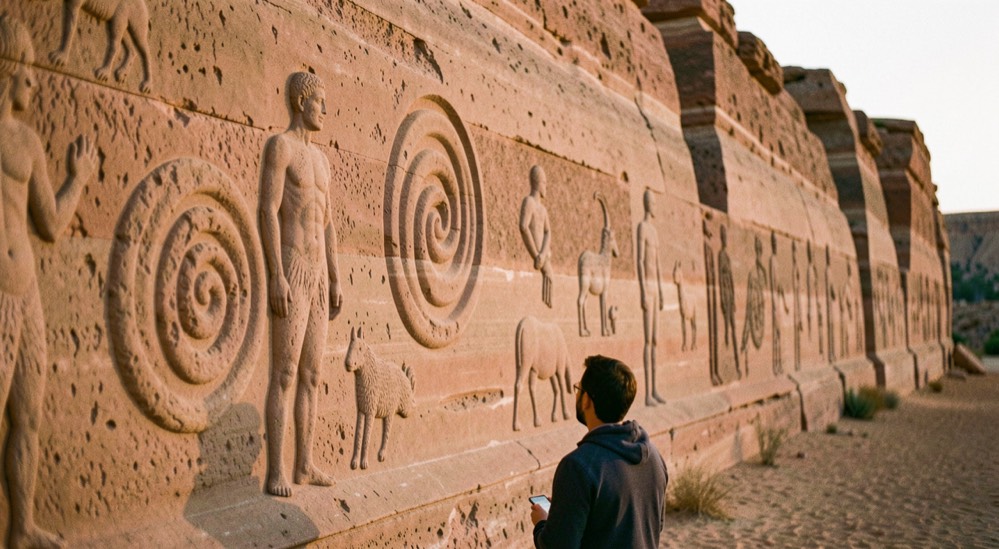
Sound is part of the archaeological record at many rock art panels and small sheltered sites, but it is rarely recorded with the care given to the images. A panel that faces a low overhang, a shallow alcove or a narrow side canyon returns a different signal than one on an open cliff face, and that difference is measurable. Reading a site without noting where a voice carries, where it dies, and what else is audible there leaves out a variable that the people who used the place also heard.
The point is not that every panel was painted for its echo. It is that acoustics are a physical property of the site, as recoverable as slope, aspect and lithology, and they belong in the same notes. Anyone who has stood in a small room with a low ceiling and heard a single instrument fill it knows how much a space contributes; the same attention applies outdoors, at a smaller scale and with more variables. Musicians who work in confined listening rooms have written about this at length, including the small-room acoustic conditions that shape how a quiet source behaves in a tight space.
What does acoustics add to reading a rock art panel?
It adds a second dataset at the same location. Petroglyphs and pictographs are read through superimposition, patina, technique and weathering. Acoustics are read through impulse response: clap once, record it, and the decay curve tells you how long the surface holds a sound and which frequencies survive.
At panels in open settings, the return is usually short and dry. Sound leaves. At panels set beneath an overhang or against a concave face, the return is longer, and a hand clap produces a distinct flutter or a brief tail. The difference between the two is often a few tenths of a second, which is small on a stopwatch and large to a listener.
Three measurements are worth taking at any panel:
- Background level, recorded for at least one minute with no one speaking. Wind, insects, water and distant traffic all register.
- Impulse response from a fixed point, usually the center of the panel's viewing area, using a hand clap or a starter pistol where permitted.
- Speech intelligibility at conversational volume, tested by having one person read a fixed sentence from the panel and another report what they heard at a set distance.
None of this requires a laboratory. A calibrated handheld recorder and a notebook cover most of it. The results belong in the site file next to the photographs, because a panel that is loud today may be quiet after a road is built a kilometer away, and the reverse is also true.
What changes at a small sheltered site?
A small sheltered site, an alcove, a rockshelter, a shallow cave with a low ceiling, compresses the same effects into a shorter distance. Reflections arrive early, within a few milliseconds, and the listener hears them fused with the direct sound rather than as a separate echo. The result is not a long reverberation but a sense of the space being close, sometimes described as a box or a shell.
Low ceilings matter more than volume. A shelter three meters deep and one and a half meters high at the mouth behaves differently from one of the same depth with a high vault. The low one reinforces mid frequencies and tends to blur consonants; the high one separates direct sound from reflection and can produce a discrete slap.
Background noise is the other half of the picture. In a sheltered site the sources are usually few and identifiable: wind across the opening, water dripping, insects, birds, the movement of the observer. An inventory of those sources, with time of day and weather noted, is as useful as the impulse response. A site that is silent at dawn and loud with cicadas at noon is two acoustic environments, not one.
How should a visitor record this without disturbing the site?
Recording is observation, not performance. Keep the source quiet. A hand clap is usually enough; a loud shout is not, and it changes the behavior of anyone else present. If a site is under tribal or agency jurisdiction, ask before making any sound test, and follow whatever conditions apply. Some panels are in areas where amplification, drones and even repeated loud claps are prohibited.
Practical sequence for a visit:
- Stand still for two minutes and write down what you hear before you make any sound.
- Note the geometry: ceiling height, depth of overhang, distance from panel to the nearest reflecting face, ground cover.
- Record one minute of ambient sound, then three hand claps from the same spot, spaced several seconds apart.
- Repeat the clap test from the far edge of the viewing area to compare positions.
- Photograph the recorder position so the measurement can be repeated later.
Keep the file names consistent with the site's existing photo and survey numbering. An acoustic note that cannot be tied to a location is of limited use.
Why does this matter for interpretation?
Because sound is one of the few site properties that a visitor can still experience in something close to its original form. Viewsheds change with vegetation and construction. Ground surfaces change. The shape of a rock face and the volume of a shelter are comparatively stable over centuries.
That stability is what makes acoustics worth recording. If a panel sits where a single voice carries clearly to a specific spot, and that spot is also where the densest imagery is, the coincidence is a fact about the site. It does not prove intent. It does establish that anyone standing there, at any period, heard the same thing.
Interpretation should stay at that level. Acoustic data can support a claim that a location was used for speech, song or signaling, but only alongside other evidence: artifact distribution, features, ethnographic accounts where they exist and are appropriate to cite. On its own, a long reverberation time is a property, not a story.
What to put in the site file
A short acoustic section, no more than a page, is enough for most panels and small shelters. Include the date, time, weather, recorder model, microphone position, ambient level, a description of the impulse response in plain terms, and a list of audible sources. Note whether the site is in an area with vehicle access, since road noise is often the dominant modern addition.
Compare the note to any earlier record of the same site. Repeat visits at different seasons are worth more than a single measurement, because insect and water noise vary sharply and can mask the response you are trying to describe.
Finally, treat the acoustic note as provisional. It describes conditions on one day. Its value accumulates when the same measurement is repeated, by the same method, at the same points, over years. That is how a site file becomes useful to someone who will never stand there.
Source: nps.gov.